Dr Beverly R Vincent
Making Science Entertaining with Explosions and Destruction
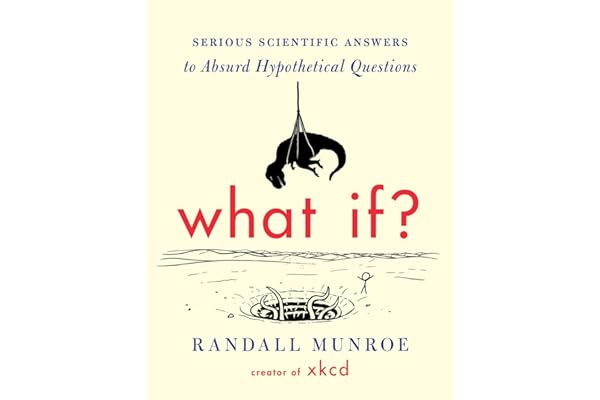
A reader comes away from Randall Munroe’s book, which is subtitled “Serious Scientific Answers to Absurd Hypothetical Questions,” with the sense that Munroe likes to blow things up and burn them to the ground, and that may well be the case. Many of his answers are accompanied by the standard disclaimer—do not try this at home—except when says, “If you do do this at home, please send me the video.”Munroe is a former robotics expert with NASA who “dropped out” to draw web comics. His most famous creation is xkcd, where three times a week he publishes a new comic, many of them presenting a fascinating—or ludicrous—take on math, physics, technology or life. His drawing style is at once simplistic and instantly recognizable. His people are stick figures, but that doesn’t diminish their cleverness. This book is illustrated with similar drawings, often to provide the punch lines to jokes delivered in the text or to demonstrate a point.Since he’s obviously very clever and resourceful, and seems willing to tackle enormous questions, his readers and fans often ask him questions. Some of these are, quite frankly, disturbing. These he relegates to interludes between batches of chapters with the appropriate heading “Weird (and Worrying) Questions from the What If? Inbox.” Usually he answers these questions with a simple NO! or a scream, or a comic of the author reporting the questioner to the police, the FBI or Homeland Security.The other questions are of the sort that college kids might come up with late at night in dorm rooms or geeks would get into heated arguments over at ComicCon. No one asks Munroe who would win in a fight between this superhero and that one, but maybe he’s keeping those for the follow-up.Many questions are about a matter of scale. How many of these objects would you need to do that? What would happen if something this big suddenly showed up or plummeted to the earth? A disturbingly large number of them ask what would happen to a person if something cataclysmic happened, like the sudden disappearance of all of their DNA (his answer unexpectedly segues into the side effects of chemotherapy and radiation treatments for cancer).Some questions have straightforward, simple answers. “What would happen to the Earth if the Sun suddenly turned off?” Everyone would freeze to death. However, Munroe is rarely content to stop there. He expands on these answers, taking them to a logical (or, some might say, illogical) extreme. He ups the ante, going far beyond what the person submitting the question had in mind—far beyond what is even remotely possible, so the answers become thought experiments. Many of his answers end with the extinguishing of life on earth or the destruction of the planet.But there’s a method to his madness. He isn’t just speculating. Okay, he does occasionally speculate, but he usually relies on hard science, with a few assumptions. While the book is entertaining and laugh-out-loud funny, it is also educational. There are very few formulas (the book does have an extensive bibliography where there are, no doubt, more than enough equations to satisfy those who demand more rigorous proofs), and Munroe takes some numerical shortcuts, but one is left with the impression that he has given these questions a great deal of thought and conducted considerable research.This would be a terrific book to give to someone with a burgeoning curiosity about the nature of things, as it demonstrates how entertaining science can be. Many of the answers are astonishing and counterintuitive, until Munroe lays out the reasoning behind them. What would happen to a glass of water if the lower half of the liquid were suddenly replaced by a vacuum. Not at all what a person might anticipate. If humanity were to die off (there he goes again), what would be the last remaining manmade source of light? Again, he digs deep, pursuing some unexpected avenues.Plus, for people who appreciate Munroe’s unique, twisted sense of humor, the book is drop dead funny. But, as humorist Dave Barry often says, don’t try to duplicate his experiments at home. By his own admission, he is not an expert on these subjects. Because he is willing to consult true experts, he just sounds like one.
AustinTiffany
Genuinely Funny and Easy to Read Trivia
I hate to do it, but this book was juuuuust shy of a 5 star rating. If I could, I’d give it 4.5 stars, but in the interest of being honest, I have to round it down to 4 stars.Don’t get me wrong; this book was great! It was actually quite entertaining, both in it’s quippy nerd-centric humor and occassionaly ridiculous (in a good way) comic drawings, all centered around some truly interesting “What If” hypothetical questions submitted by various fans of Randall Munroe’s web comic series. There are footnotes throughout each chapter in this book, and one would expect these footnotes to be normal, clarifying statements or references, and in some cases they are … but in most cases, they’re actually parenthetical jokes, most of which are actually pretty funny. There’s a chapter about building a Lego bridge where this gets especially funny.It’s a fairly simple, easy to read light trivia book with some memorable bits of information … that said, however, there are some areas where this book could have been improved.For one thing, the cover artwork on this book is misleading; there is no chapter exploring “How long would it take the Saarlac from Star Wars to digest a T-Rex”?For another, several of the submitted questions in this book, I feel like, could have been resolved with a simple Google search or about 10 to 15 minutes of research. Some of the questions Munroe answered seemed trite and a waste of time (beyond even what the word “trivia” entails). In one case, Munroe answered a question regarding what would happen if the sun went out, and he prefaced it with “This question has been answered by everyone before me, and is easily resolved by Google searching these terms, but I’ll answer it anyway.” He goes on to, appropriately, answer the question in a rather grim and satirical manner, but one can’t help feel afterwards that it was ultimately a rather empty chapter. In other cases, he answers some truly cool “what if” scenarios, but doesn’t answer some pretty big questions that came up in my mind. And not all of the questions in this book were phrased in the sense of a “what if” type of scenario. Perhaps the most aggravatingly misplaced chapter in this book was one about what would be the last human-made light source. Not only was this not really a “what if” type of scenario, but this type of thing could have been answered through about 10 minutes of Google searching, maybe less.I dropped a lot of criticisms compared to praises, yes, but ultimately I liked the book, and I liked the concept. I hope Randall Munroe does another book, but maybe works on refining a few elements. Some of his answers were a bit scattered and too “criticizing” sounding, others were a bit incomplete, and others were kind of a waste of time. But his writing style was generally entertaining, easy to read, and quite funny. I think I probably laughed 2 or more times for all but one or two chapters in this book.